It is dangerous to climb on a roof. Moreover, it may not be the most effective way to identify potential issues. These days, more and more people prefer drone inspections instead of the traditional ladder and clipboard method. This technique is quicker and safer than the previous one. Often, it helps to see better what is wrong with the house’s roofing.
This article addresses the process of drone roof inspection in Maryland. It discusses the importance of using this method for local climate conditions. Perhaps you have been looking for ladder-free roof inspection services in Maryland before. Here is your opportunity to learn more about them in clear and understandable language.
Why Maryland Homes Need Regular Roof Checks
The climatic conditions in Maryland are not kind to roofs. Hot and humid summers, coupled with winters that bring ice, snow, and freezing temperatures, are not good for roofs. This can cause wear and tear of materials due to the weather conditions. In addition, storms are common in Maryland. It is clear that roofs in Maryland age faster than those in other areas.
Most people do not check their roofs until after there is a roof leak. At this stage, it means that water has managed to find its way into the attic or walls through the roof. Small things are hard to spot. For example, loose shingles, tiny cracks, and worn-out flashing. Spotting such problems is going to help you save some money. This is because the small problem will be sorted before it becomes a big one.
Getting a good Drone Roof Inspection in Maryland can make it easy to detect such problems. There is no need for homeowners to wait until they spot any issues.
What Is a Drone Roof Inspection?
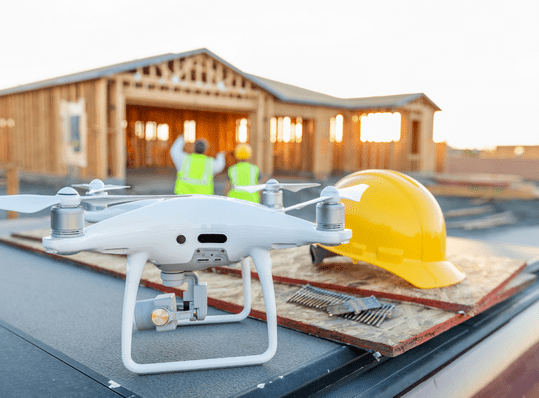
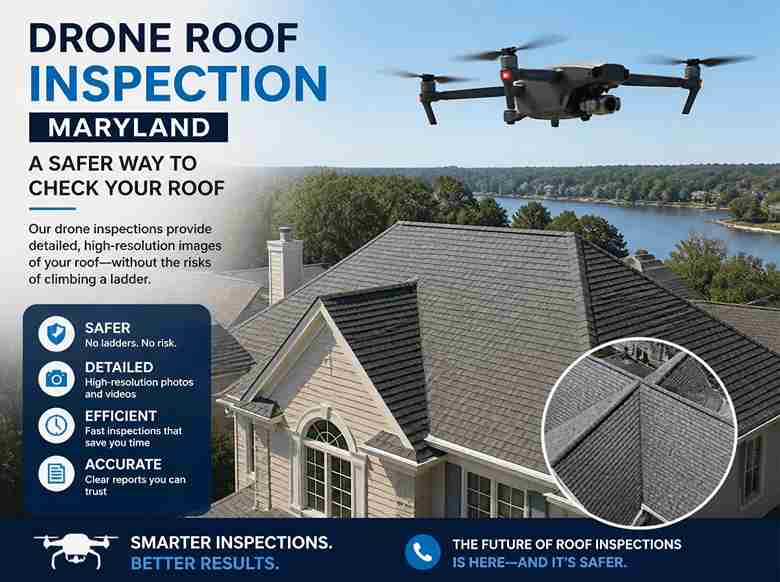
A drone roof inspection uses a small, camera-equipped drone. It flies over and around a roof. It captures detailed images and video. It reaches angles a person on a ladder simply can’t reach safely. The drone hovers close enough to spot cracked shingles, damaged flashing, or debris buildup. Nobody has to step foot on the roof itself.
This method has become popular for a simple reason. It removes the physical risk entirely. Falls from roofs and ladders are one of the most common causes of injury during home inspections and repairs. A drone eliminates that risk. It still gives a thorough, close-up view of the roof’s condition.
How It Compares to a Traditional Ladder Inspection
| Factor | Drone Roof Inspection | Traditional Ladder Inspection |
| Safety | No one climbs the roof | Involves real fall risk |
| Speed | Usually done in minutes | Can take much longer |
| Coverage | Captures full roof from multiple angles | Limited to accessible areas |
| Weather Sensitivity | Can be delayed by high wind | Also weather-dependent |
| Documentation | Detailed photo and video record | Often just written notes |
The table above shows why more inspectors like drone-based checks. This holds true for steep roofs. It also holds true for homes with multiple stories. A ladder isn’t always practical or safe in these cases. Alhumd Inspection uses this exact approach for most roof checks now. It gives a clearer, safer result than the old method.
What a Drone Inspection Actually Checks
A thorough inspection covers more than just a quick flyover. Here’s what’s typically included in a full check:
| Area Checked | What Inspectors Look For |
| Shingles | Cracking, curling, or missing pieces |
| Flashing | Rust, gaps, or separation around vents and chimneys |
| Gutters | Clogs, sagging, or improper drainage |
| Moss and Algae | Growth that can trap moisture and damage material |
| Structural Wear | Sagging areas or uneven roof lines |
This kind of detailed check gives homeowners a much clearer picture. A quick visual scan from the ground rarely offers this much detail. That’s often all a standard walkthrough provides.
Why This Matters More in Maryland
Maryland’s mix of humid summers and freezing winters wears down roofing materials fast. Ice can work its way under shingles during freeze-thaw cycles. Summer humidity encourages moss and algae growth. This slowly breaks down roofing material over time.
Storm damage is another factor. Heavy rain and wind can loosen shingles. They can damage flashing too. These issues aren’t always visible from the ground. Regular roof inspection without a ladder gives Maryland homeowners a way to catch this kind of damage early. This helps before it turns into a leak or a much larger repair bill.
The Inspection Process, Step by Step
Getting a drone roof inspection is a fairly simple process. Here’s roughly what to expect:
- Scheduling – Book a time that works, ideally during calm, dry weather for the clearest results.
- Setup – The inspector arrives and prepares the drone, checking wind conditions and flight safety.
- Flight and Capture – The drone flies over the roof, capturing high-resolution photos and video from multiple angles.
- Review – Footage is reviewed closely for any signs of damage, wear, or potential problem areas.
- Report – A detailed report with images is shared, showing exactly what was found and where.
This process usually takes far less time than a traditional inspection. There’s no need to set up ladders. There’s no need to physically climb around the roof. Alhumd Inspection typically completes a full flight and review within a single visit. Homeowners get answers the same day.
Who Should Consider a Drone Roof Inspection?
Homeowners preparing to sell are good candidates. So are buyers evaluating a new purchase. Anyone who’s recently dealt with a storm should consider one too. It’s also a smart yearly check for homeowners who want peace of mind. This skips the hassle of a ladder-based inspection.
Steep or high roofs benefit the most. These are exactly the situations where traditional ladder inspections carry the highest risk. Multi-story homes are far easier and safer to inspect from the air. This beats a ladder propped against the side of the house. Alhumd Inspection has found that these are also the cases where drone footage reveals the most. Ground-level views simply can’t capture that kind of detail.
Common Questions Homeowners Have
Most people think that an aerial shot from a drone will just show the roof surface. However, current drones come with high-definition cameras. Such cameras can see cracks, missing granules, and all the detailed damage to the roof. Some people question whether weather affects scheduling. It does, but to a limited degree. Strong winds or rainfall might affect scheduling.
Price is another concern that arises quite frequently. Inspecting the roof using drones is quite affordable compared to other options. The process takes less time than usual . In addition, there is no need for any specialized ladders or equipment.
Conclusion
Drones can be utilized in conducting a thorough roof inspection, which is safer and faster than other methods. This is especially crucial in a state such as Maryland, where weather conditions affect the roofing material throughout the year. The roof inspection aids in identifying defects at an early stage.
Homeowners who’ve never had this kind of inspection are often surprised. So much detail shows up in the footage. A quick glance from the ground can easily miss these details. Even a careful ladder climb can miss them too. A clear, documented record of your roof’s condition also makes future repairs simpler. It makes insurance conversations easier too, since there’s no guesswork involved.
Alhumd Inspection offers this exact kind of service for homeowners across Maryland. It’s a safer, more detailed way to check their roof. If it’s been a while since your last roof check, it’s worth scheduling one. The same goes if a recent storm has you wondering about hidden damage. This helps before small issues turn into expensive repairs.
Ready to see your roof from a whole new angle? Contact Alhumd Inspection today to schedule your drone roof inspection.
FAQs
Yes, high-resolution drone cameras often capture more detail than a person can see from a ladder.
Most inspections are completed within 20 to 30 minutes, depending on roof size.
Yes, high wind or heavy rain can delay a flight for safety and image quality reasons.
Yes, since no one has to climb onto the roof itself.
Most homeowners benefit from an annual check, plus one after any major storm.