By Ahmed Hassan, Maryland Licensed Home Inspector #34028 · InterNACHI Certified · Updated October 2026
Your tenant gives notice, the new lease starts in three weeks, and your Baltimore City rental license is about to expire. Without a current license you can’t legally rent the unit, and you lose the right to collect rent for the time it’s unlicensed. The Baltimore City rental inspection checklist itself is short: 17 pass/fail items and 4 “refer” items on one Department of Housing and Community Development (DHCD) form. Units still fail it, and the cause is often a cheap part like a missing outlet cover or a dead smoke alarm. This guide walks through every item, the fixes that get a unit passing, the rule changes that took effect on January 1, 2026, and the lead paint step that’s separate from the license inspection. Use it as your walk-through before the inspector arrives.
What is the Baltimore City rental license inspection?
A Baltimore City rental license inspection is a basic health and safety check of a rental unit, performed by a Maryland-licensed home inspector who is registered with DHCD. A passing report is required before the City will issue or renew a rental license.
It isn’t a full home inspection. The inspector only checks the items on the City’s form and gives a pass, fail or refer for each. Under Baltimore City Code, Article 13, §5-7, the inspector must sign the report under oath and certify no financial interest in the property or its owner (Baltimore City Code §5-7).
Quick answer: Every rental unit in Baltimore City needs a license, including single-family homes and duplexes. Book a DHCD-registered inspector no more than 90 days before you apply, fix anything that fails, and submit the signed report with your application. Since January 1, 2026, every license runs a flat two years.
Who needs a rental license in Baltimore City?
Every residential rental unit in Baltimore City must be registered, inspected and licensed. That has included one- and two-family homes since August 1, 2018, when Council Bill 18-0185 removed their old exemption (Baltimore City DHCD).
Non-owner-occupied homes that aren’t rented still need yearly registration with DHCD, but not a rental license. Units that already pass regular government inspections, such as Section 8 Housing Choice Voucher units, can submit their passing result instead of a separate third-party inspection.
What changed for Baltimore landlords in 2026?
The Strengthening Renters’ Safety Act took effect on January 1, 2026 (Baltimore City DHCD). For most small landlords, four changes matter:
| Rule | Before 2026 | From January 1, 2026 |
|---|---|---|
| License term | 1, 2 or 3 years, based on violation history | Flat 2 years for every license |
| Selling a licensed rental | License could transfer | No transfers; the new owner needs a license within 60 days |
| Posting the license number | Not required | Required in common areas, leases and ads; $250 citation if missing |
| Large problem buildings (20+ units) | Standard enforcement | “Priority dwelling” status, inspections at least twice a year |
The sale rule catches investors most often. If you buy a tenant-occupied rowhome in Hampden or Highlandtown, put the license inspection on your closing checklist. You have 60 days, and they go fast.
The Baltimore City rental inspection checklist, item by item
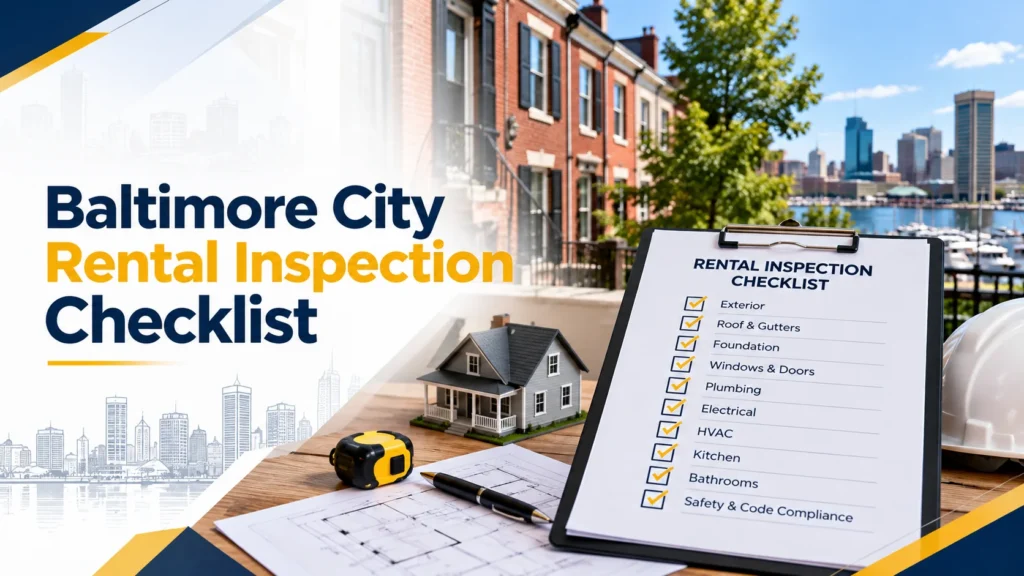
These are the items on DHCD’s official rental license inspection form (DHCD inspection form), with what typically causes a fail. Walk the unit with this list a week before the inspection.
Pass/fail items (17)
| # | What the inspector checks | What usually fails | Quick fix |
|---|---|---|---|
| A | Handrail on interior and exterior stairs with more than 3 risers | Missing rail on basement or back-porch steps | Install a secured rail |
| B1 | Gas service metered and on | Gas shut off between tenants | Restore service before the visit |
| B2 | Electric service metered and on | Utilities off in a vacant unit | Restore service |
| C | No exposed electrical wiring in living areas | Open splices, missing box covers in basements | Box and cover connections |
| D1 | Cover plates on all outlets | Cracked or missing plates | Replace plates (a few dollars each) |
| D2 | GFCI protection where water is present (kitchen, bath) | Standard outlets beside sinks | Install GFCI outlets |
| D3 | Lights work; switch plates in place | Dead bulbs, missing switch plates | Replace bulbs and plates |
| E | Smoke alarms installed and working | Expired units, missing alarm on a level | Install compliant alarms (see below) |
| F | Carbon monoxide alarms installed and working (where applicable) | No CO alarm in a unit with gas appliances | Install CO alarms |
| G1 | Hot and cold water; hot water at least 110°F | Water heater set too low or failing | Adjust or service the water heater |
| G2 | Plumbing fixtures don’t leak | Dripping faucets, loose traps | Replace washers or cartridges |
| G3 | Toilets flush properly | Running or weak toilets | Replace flapper or fill valve |
| H | No interior leaks from supply or waste lines | Stains under sinks, active drips | Repair the line, dry the area |
| I | Windows that are meant to open, open, close and lock | Painted-shut sashes, broken locks | Free sashes, replace locks |
| J | Exterior walls free of openings that let in rain or snow | Gaps at rear additions, failed brick joints | Seal, patch or repoint |
| K | Gutters and downspouts carry water away | Missing downspout, gutter dumping at the foundation | Reattach or add an extension |
| L | Working heat | Furnace or boiler not running in fall | Service before the visit |
Refer items (4)
These items aren’t simple pass/fail. If the inspector can’t pass them, they’re referred to DHCD, and a City Housing Code Enforcement inspector may do a full re-inspection.
| # | What the inspector checks |
|---|---|
| M | Interior is clean and sanitary |
| N | No signs of rodents, insects or other pests inside |
| O | A basement bedroom has proper fire egress (N/A if there’s none) |
| P | No rodent burrows outside |
A referral slows everything down. Clear trash, treat for pests and fill burrows before inspection day. If a basement room has no egress window, don’t call it a bedroom in your lease or listing.
Save this section. Print the two tables and tick each item yourself before you pay for the inspection.
Smoke and CO alarms: the item that’s easiest to get wrong
Smoke alarms are an easy item to fail because Maryland’s rules are stricter than many owners realize. Under the Maryland smoke alarm law, in effect since January 1, 2018, battery-only alarms must be sealed 10-year units with a hush button. Any alarm, hardwired or battery, must be replaced 10 years after the date printed on its back (Baltimore County Fire Marshal summary of the state law).
In practice, that means three checks:
- Look at the date on the back of every alarm. No date, or older than 10 years, means replace it.
- Replace a hardwired alarm with another hardwired alarm, not a battery unit.
- Put an alarm on every level and in every bedroom. If the unit has a gas furnace, gas water heater, gas range or attached garage, add CO alarms too.
Lead paint: the separate step pre-1978 rentals can’t skip
Lead compliance is a separate legal requirement from the City license inspection. If your Baltimore rental was built before 1978, the Maryland Department of the Environment (MDE) requires you to register it every year, currently $30 per unit, renewed by December 31 (MDE Lead Registration). Since January 1, 2015, you also need a new lead inspection certificate at every change of occupancy.
Much of Baltimore City’s rowhome stock was built long before 1978, so this applies to most rental owners here. Plan the lead inspection for the same vacancy window as your license inspection. Both need a vacant, clean unit, and doing them together saves a second trip. Alhumd offers lead risk reduction inspections alongside the license inspection.
How to get your Baltimore rental license, step by step
How long it takes depends mostly on you. Most delays come from failed items, permits for repairs and missing lead paperwork.
- Register the property on DHCD’s online registration portal. In-person help is at 417 E. Fayette Street, Room 100, weekdays 8:30 a.m. to 4:30 p.m.
- Handle lead compliance with MDE if the home was built before 1978.
- Walk the unit with the checklist above and fix what you find.
- Hire a Maryland-licensed home inspector registered with DHCD. You can’t self-certify.
- Inspect no more than 90 days before you apply. For buildings with 9 or fewer units, every unit must be inspected.
- Get the signed report and certificate of compliance from the inspector.
- Apply and pay the City’s fees online, uploading the report.
- Post your license number in common areas, leases and advertisements.
One rule surprises landlords: the inspector can’t repair failed items or recommend a contractor to fix them. Line up your own handyman or electrician before inspection day so re-inspection happens quickly.
What happens if your unit fails?
A failed inspection doesn’t end in a fine. It means you fix the listed items and schedule a re-inspection before you apply. Some fixes, such as electrical work or a new water heater, may need a permit, so build that time in.
The bigger risk is renting while unlicensed. A landlord without a valid license loses the right to collect rent for that period. In a failure-to-pay-rent case, the landlord must prove a valid license and include the license number in the complaint (Maryland People’s Law Library). Violations can also bring fines of up to $1,000 per offense.
Baltimore City vs Baltimore County: don’t mix up the rules
Baltimore City and Baltimore County are separate jurisdictions with separate rental programs. A license from one means nothing in the other. If you own rentals in Towson, Catonsville or Dundalk, those fall under the County, which has its own registration and inspection rules. See our Baltimore County rental inspection page for that process.
Is a rental license inspection the same as a home inspection?
No. A rental license inspection checks a fixed list of basic safety items, and the result is pass, fail or refer. A home inspection is a full evaluation of the roof, structure, systems and appliances, usually before a purchase.
If you’re buying a rental property, you need both, at different times. Get a full home inspection before closing, then the license inspection within the 60-day window after you take ownership. A home inspection won’t count as a license inspection. It also has no pass or fail, as we explain in can a house fail a home inspection.
Book your inspection
Most Baltimore City landlords can pass on the first visit if they work through the checklist a week ahead. Fix the small parts, confirm utilities and heat are on, check every smoke alarm date, and schedule the lead inspection in the same vacancy window.
When the unit is ready, see how our Baltimore City rental inspection works. Alhumd’s inspectors are Maryland licensed and registered with DHCD, and we serve rentals across Baltimore City and County. You get a signed report the same day. You can book online with code SELFSCHEDULE for $20 off, or call (667) 686-7281. Fees and rules change, so confirm current City fees on the DHCD portal before you apply.
A license costs far less than a month of rent you can’t collect.
Frequently asked questions
What is on the Baltimore City rental inspection checklist?
The checklist has 17 pass/fail items and 4 refer items. They cover stair handrails, active gas and electric, exposed wiring, outlet covers and GFCI outlets, working lights, smoke and carbon monoxide alarms, hot water of at least 110°F, leaks, toilets, windows, exterior openings, gutters and heat. The refer items cover cleanliness, pests, basement bedroom egress and rodent burrows.
How long is a Baltimore City rental license valid?
Since January 1, 2026, every Baltimore City rental license has a flat two-year term. Before that, renewals ranged from one to three years depending on the property’s violation history.
How far in advance can I do the rental license inspection?
The inspection can’t be done more than 90 days before you submit your license application. Schedule it once repairs are done and the unit is ready, then apply soon after you receive the signed report.
Who can do a Baltimore City rental license inspection?
Only a Maryland state-licensed home inspector who is registered with Baltimore City DHCD. The inspector must certify no financial interest in the property or its owner. Landlords can’t inspect and certify their own units.
What happens if my rental fails inspection?
You repair the failed items and schedule a re-inspection before applying. The inspector can’t repair items or recommend a contractor, so arrange your own repairs. Some repairs, such as electrical work, may need a permit.
Do I need a lead certificate for a Baltimore City rental?
If the unit was built before 1978, Maryland law requires yearly MDE registration and a new lead inspection certificate at every change of occupancy. This is separate from the City license inspection, so plan both for the same vacancy.
Do I need a new rental license if I buy a rental property?
Yes. Since January 1, 2026, Baltimore City rental licenses don’t transfer to a new owner. The buyer must get a new license within 60 days of the transfer of ownership.
Does Section 8 inspection count for a Baltimore rental license?
Yes, in most cases. Units that pass periodic government inspections, such as Housing Choice Voucher inspections, can submit proof of the most recent passing inspection instead of a separate third-party license inspection.
Can I collect rent without a rental license in Baltimore City?
No. A landlord without a valid license loses the right to collect rent for the unlicensed period. In a failure-to-pay-rent case, the landlord must prove a valid license and list the license number in the court complaint.
How much does a Baltimore City rental inspection cost?
Inspectors set their own prices, and the City doesn’t regulate them. Alhumd’s current price is on our scheduling page, and the code SELFSCHEDULE takes $20 off. City license fees and MDE lead registration fees are separate.