Quick answer: A standard home inspection in Maryland runs $350 to $600 for most single-family homes. Add radon testing ($115–$175), a termite report ($65–$150), and mold sampling if needed, and most buyers in Baltimore, Howard, or Montgomery County walk out spending $550–$800 total for a properly covered transaction.
That’s the short version. The real answer — the one that actually helps you budget and not get surprised at closing — depends on your specific property, what county you’re in, and which of Alhumd’s inspection services apply to your situation.
This guide breaks all of it down.
User Intent: What You’re Actually Asking
Before diving into numbers, it helps to know that “how much does an inspection cost” in Maryland means different things to different people:
- Home buyers under contract wanting to know what to budget before they wire the inspector
- Sellers considering a pre-listing inspection to get ahead of negotiation surprises
- Landlords in Baltimore City or County who need a legally required rental inspection before a new tenancy
- New construction buyers wondering about a pre-drywall inspection before walls go up
- Homeowners dealing with a specific issue — mold smell, termite swarms, water in the basement
Each of these situations has a different answer. Let’s go through them.
Standard Home Inspection Costs in Maryland (2025–2026)
For a licensed home inspection of a single-family home, here’s what Maryland buyers realistically pay:
| Property Size | Typical Cost Range |
|---|---|
| Condo / Under 1,000 sq. ft. | $250 – $325 |
| 1,000 – 1,500 sq. ft. | $325 – $400 |
| 1,500 – 2,500 sq. ft. | $400 – $500 |
| 2,500 – 4,000 sq. ft. | $500 – $600 |
| 4,000+ sq. ft. or complex property | $600 – $800+ |
These tiers reflect what most Maryland inspection companies — including Alhumd — use as their base pricing structure. The flat-rate or tiered-by-sqft model is standard; per-hour pricing is uncommon here.
Why Maryland Costs More Than Many States
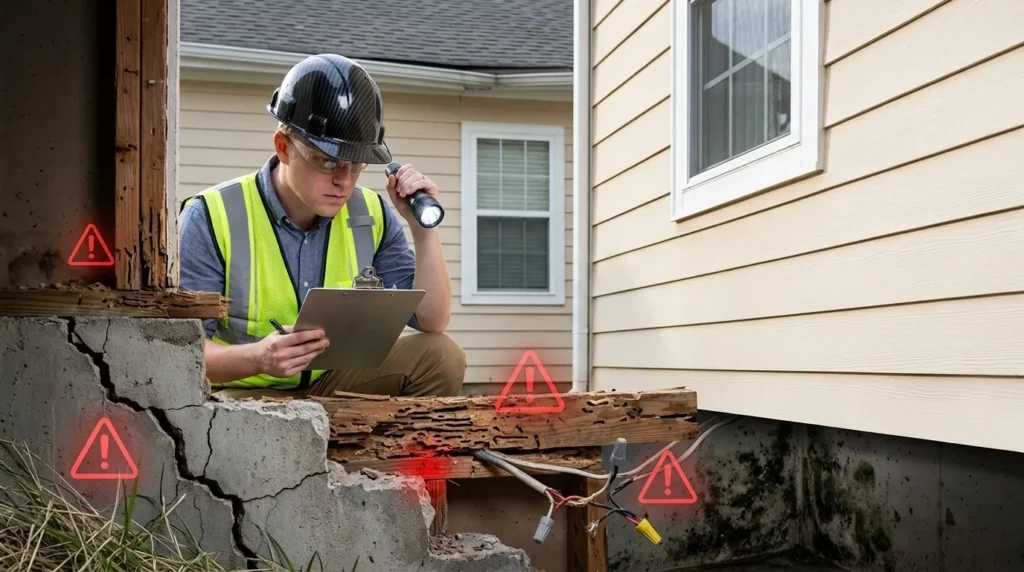
Maryland’s housing inventory skews older. Walk through almost any neighborhood in Baltimore City, Annapolis, Frederick, or Towson and you’re looking at homes built between 1920 and 1975. These properties have:
- Oil-fired boilers — less common in newer builds, more time-intensive to evaluate
- Knob-and-tube or aluminum branch circuit wiring in some pre-1970 homes
- Galvanized steel supply lines that corrode from the inside over decades, restricting flow before they fail visibly
- Stone or block foundations susceptible to hydrostatic pressure from Maryland’s freeze-thaw cycle
- Finished basements that hide decades of moisture intrusion behind drywall
An inspector who actually does their job on a 1960s Howard County colonial isn’t just ticking boxes. They’re reading a property that has been stressed by 60 Maryland winters. That takes more time — and honest pricing reflects it.
The Baltimore–Washington corridor (Howard, Montgomery, Prince George’s County) also runs slightly higher than rural Western Maryland or the Eastern Shore, reflecting local market rates and operating costs.
Every Inspection Service Alhumd Offers — and What Each Costs
Alhumd Inspections serves buyers, sellers, and landlords across Howard, Montgomery, Baltimore, Frederick, and surrounding Maryland counties. Here is every service they perform, with honest pricing context.
Home Inspection
The core service. Alhumd’s licensed inspectors evaluate:
Structural & Exterior: Foundation, basement walls, framing, roof system (including flashings around chimneys and penetrations), exterior cladding, grading and drainage
Mechanical Systems: HVAC (furnaces, heat pumps, central AC, and oil boilers where present), plumbing supply and drain lines, water heater, electrical panel, branch circuit wiring at accessible locations
Interior: All rooms, ceilings, floors, windows and doors, attic insulation and ventilation, visible crawl space conditions
What shows up most often in Maryland homes: Efflorescence on basement walls (white mineral deposits — a sign water is pushing through masonry), double-tapped breakers, HVAC systems past their 15–20 year service life, improper dryer venting, roof flashings pulling away from chimney saddles, and galvanized supply lines showing reduced pressure at fixtures.
You receive a same-day digital report with photographs, written findings, and items organized by severity. There’s no “pass/fail” — it’s a condition report. Your job (with your agent) is to decide what matters in negotiation.
Base pricing: Determined by square footage and property age. Call (667) 686-7281 or schedule at alhumdinspections.com for a quote on your specific address.
Radon Testing
This one matters in Maryland more than most buyers realize.
Radon is a radioactive gas — no color, no smell, no taste — produced naturally when uranium in Maryland’s bedrock and soil breaks down. It enters homes through foundation cracks, floor drain openings, gaps around service pipe penetrations, and hollow block foundation walls. It accumulates. At elevated concentrations, the EPA classifies it as the second leading cause of lung cancer in the United States, behind only smoking.
Maryland’s geology puts several counties firmly in EPA Radon Zone 1 — the highest-risk designation — including Montgomery, Frederick, Washington, Allegany, and Garrett. Montgomery County has gone a step further: it legally requires radon testing for single-family home sales. Even outside Montgomery County, skipping radon testing in Maryland is a risk most buyers shouldn’t take.
The test runs for a minimum of 48 hours under closed-house conditions. Alhumd uses continuous electronic radon monitors — not passive charcoal canisters — which provide more accurate, tamper-evident readings over the full test period. Results come with your inspection report.
The EPA action level is 4 picocuries per liter (pCi/L). If your result comes back above that, mitigation is possible (sub-slab depressurization systems typically run $800–$2,500) — and it’s a legitimate negotiating point with the seller.
Maryland market rate: $115–$200 as a standalone; typically reduced when bundled with a home inspection.
Termite Inspection (WDI Report)
The formal name is a Wood-Destroying Insect inspection. The form you receive is a standardized Maryland state document — lenders and real estate attorneys refer to it as the WDI report or “termite letter.”
Maryland’s climate — hot, humid summers with substantial rainfall — is ideal for subterranean termites, the most destructive species in the state. Subterranean colonies build mud tubes from the soil to wood members and can work inside wall framing, floor joists, and rim boards for years before a homeowner sees anything at the surface.
Most Maryland mortgage lenders — conventional, FHA, and VA — require a clear WDI report before they’ll fund the loan. But even when your lender doesn’t require it, consider the risk: termite damage isn’t cosmetic. Compromised floor joists, sill plates rotted through from carpenter ants, or structural beam damage can run from several thousand to tens of thousands of dollars to remediate properly.
The WDI inspection looks for:
- Active infestations of termites, carpenter ants, carpenter bees, and powder post beetles
- Evidence of past wood-destroying insect damage
- Conditions conducive to infestation — wood-to-soil contact, inadequate crawl space ventilation, excessive moisture, wood debris near the foundation
That last point matters. A property might show no active insects but significant conducive conditions. That’s a future problem the report will document.
Maryland market rate: $65 – $150.
Mold Testing and Inspection
Maryland averages summer relative humidity above 70%. Basements, crawl spaces, attic decking, HVAC air handlers, and wall cavities behind bathroom tile all retain moisture. When moisture stays put, mold follows — often before there’s any visible sign.
Mold testing involves two distinct components:
Visual inspection: The inspector examines all accessible areas for visible mold growth, moisture staining, musty odors (indicative of microbial volatile organic compounds), and elevated moisture readings using a calibrated moisture meter on drywall, subflooring, and framing. This alone identifies obvious problems.
Air sampling: Spore trap cassettes collect air samples — typically from indoor locations plus a baseline outdoor sample for comparison. These go to a certified third-party environmental laboratory. Results quantify the types and concentrations of mold spores present and return within 48–72 hours. Surface samples are added when visible growth needs species identification for remediation planning.
When mold testing is worth prioritizing:
- The basement has water staining, efflorescence, or a history of flooding
- There’s a musty smell in any area of the home
- The HVAC system hasn’t been serviced or cleaned in years (mold on coils disperses spores through every room)
- The home has been vacant — stagnant air and no dehumidification accelerates mold growth
- Any prior owner disclosed water intrusion
Maryland market rate: $150 – $300+ depending on number of air samples. Lab fees are included.
Thermal Imaging Inspection
A thermal (infrared) camera doesn’t see through walls. What it does see is surface temperature variation — and that variation reveals a surprising amount about what’s happening inside a wall cavity, ceiling assembly, or electrical panel.
What thermal imaging finds that a standard visual inspection cannot:
Moisture intrusion: Water-saturated insulation and drywall cools differently than dry material. Thermal imaging maps active leaks and moisture migration before surface staining appears.
Electrical hot spots: Connections under load that are running hotter than they should — often a sign of loose terminations, overloaded circuits, or failing components — show up clearly on an infrared scan.
HVAC duct leaks: Conditioned air escaping into unconditioned attic space before it reaches living areas shows as a cold or hot anomaly along the duct run.
Insulation gaps: Maryland’s pre-1980 housing stock was frequently insulated to standards well below what’s considered acceptable today. Thermal imaging maps exactly which wall sections lack insulation — quantifying what you’re heating and cooling straight through the exterior.
Alhumd also uses drone technology for roof and exterior evaluations on properties where access is limited or roof pitch makes walking dangerous. Aerial thermal imaging adds another layer of documentation to the report.
Thermal imaging is typically offered as a bundled add-on to the standard home inspection.
Pre-Drywall Inspection
New construction buyers in Clarksburg, Urbana, Odenton, Bowie, or anywhere else in Maryland face a specific problem: by the time you do a final walkthrough, most of the construction quality is permanently hidden behind drywall, flooring, and finish work.
The pre-drywall inspection window opens after framing, rough electrical, plumbing rough-in, and HVAC rough-in are complete — before insulation and drywall go up. This is the only point in a new home’s life where you can verify:
- Framing is plumb and properly braced
- Electrical boxes are at correct heights, rough-in is neat, proper wire gauges used for circuit loads
- Plumbing supply lines are properly supported, drain lines have correct slope
- HVAC ductwork layout is logical, supply and return balance is workable
- Insulation type and depth is specified correctly, especially at exterior walls and attic knee walls
- Basement waterproofing membrane is continuous before backfill
Maryland’s pace of new construction — particularly in Howard, Frederick, and Montgomery counties — means individual homes don’t always get the attention they should before the drywall crew arrives. An independent set of eyes at this stage costs relatively little compared to correcting framing or electrical errors after drywall installation.
Maryland market rate: $350 – $550 based on home size.
Pool Inspection
A pool inspection is a specialized evaluation of the entire aquatic system — not a quick visual look at the water.
Alhumd’s pool inspections cover:
Structural: For concrete/gunite pools, the shell is examined for cracks, spalling, or surface deterioration. For vinyl liner pools, the liner condition and tracking are checked. Coping and decking around the perimeter are evaluated for structural integrity and trip hazards.
Equipment pad: Pump and motor, filter (sand, cartridge, or DE), heater or heat pump, chlorinator or salt cell, automation/control systems — all operated and evaluated.
Safety compliance: GFCI protection on all pool-area receptacles, self-closing/latching gate hardware on pool enclosures, anti-entrapment drain covers (Virginia Graeme Baker Act compliance), and bonding of the pool shell and equipment.
Why it matters: A failing pump seal, a heater heat exchanger that’s cracked, or a vinyl liner that’s two seasons away from replacement aren’t obvious during a showing. Pool equipment replacements run $1,500–$4,500 depending on component. A liner replacement on an in-ground pool can exceed $10,000. Structural repairs to a gunite shell start much higher. An inspection that catches deferred equipment maintenance before closing gives you documented leverage.
Baltimore City Rental Inspection
Baltimore City requires all rental properties to hold a current rental license issued by the Baltimore City Department of Housing and Community Development (DHCD). Obtaining or renewing that license requires a passing inspection by a licensed inspector.
This is not optional — landlords operating rental units in Baltimore City without a valid license are subject to code enforcement action, fines, and in some cases inability to collect rent.
Alhumd is registered with Baltimore City DHCD to perform these inspections. The scope focuses on habitability and safety: adequate heat, functional plumbing and electrical systems, structural integrity, proper egress, working smoke and CO detectors.
Pricing is based on unit count.
Baltimore County Rental Inspection
Separate from Baltimore City, Baltimore County mandates that all one-to-six-unit rental properties be inspected by a licensed inspector before a new tenant occupies the unit. The inspection standards and form are distinct from Baltimore City’s process.
Multi-unit pricing is available. Landlords with multiple properties can contact Alhumd directly to discuss scheduling.
What You Should Actually Budget: Real Scenarios
Scenario 1: Buying a 2,000 sq. ft. home built in 1975 in Ellicott City
- Standard home inspection: ~$450
- Radon testing (EPA Zone 1 proximity, older basement): ~$150
- WDI/Termite report (lender-required, older home): ~$100
- Realistic total: $650–$700
Scenario 2: Purchasing a new construction townhome in Clarksburg
- Pre-drywall inspection: ~$400
- Final home inspection: ~$400
- Radon testing: ~$150
- Realistic total: $900–$1,000 (two inspection stages)
Scenario 3: Buying a 1940s rowhouse in Baltimore City
- Standard home inspection: ~$400
- Radon test: ~$150
- Termite (WDI): ~$100
- Mold air sampling (basement moisture staining noted in listing photos): ~$200
- Realistic total: $800–$900
Scenario 4: Baltimore County landlord, new tenancy starting
- Rental inspection: contact Alhumd for per-unit pricing
The $400 “average” figure you see everywhere is rarely the final number for Maryland buyers who inspect properly. Budget $550–$800 for most residential transactions and you’ll be prepared.
What Drives the Price Up (and What Doesn’t)
Legitimate cost factors:
- Finished basement adds square footage and inspection time
- Multiple HVAC systems (a 3,500 sq. ft. home often has two zones)
- Oil boiler systems require more evaluation time than standard gas furnaces
- Detached structures (garages, sheds, workshops) can be added for a fee
- Age of construction — pre-1960 homes consistently run higher
- Mileage to rural properties outside Alhumd’s core service area
Not a cost factor:
- Whether the house is “nice” or newly renovated — renovation quality is actually something inspectors look at critically, since DIY or unpermitted work creates its own category of issues
Red flag when shopping inspectors: An inspector quoting $199 for a full inspection of a 2,000 sq. ft. home is either rushing (an inspection that thorough takes 2.5–3.5 hours minimum) or omitting scope. In a transaction where the median Maryland home price is above $400,000, the difference between a $400 and a $500 inspection is not where you cut costs.
Maryland Licensing: What to Verify Before You Book
Maryland takes home inspector licensing seriously. The Maryland Department of Labor (DLLR) requires every inspector performing paid inspections to hold a current license obtained through:
- Completing 72 hours of approved classroom-based training (not online-only — Maryland specifically requires on-site instruction)
- Passing the National Home Inspector Examination (NHIE) — a standardized, psychometrically validated professional examination
- Meeting general liability insurance requirements
- Paying the state licensing fee
You can verify any Maryland inspector’s license status at the Maryland Department of Labor’s license lookup portal. Alhumd’s inspectors are fully licensed, insured, and carry memberships with industry organizations including InterNACHI (International Association of Certified Home Inspectors), which requires ongoing continuing education.
Practical implication: Don’t hire an inspector based on price alone. Verify their license, look at their actual reports (most reputable companies will share a sample), read their reviews, and confirm they carry E&O (errors and omissions) insurance in addition to general liability.
How Inspection Findings Affect Negotiation
Maryland real estate contracts typically include an inspection contingency period. During that window, buyers can:
- Request specific repairs from the seller
- Request a price reduction or seller credit at closing in lieu of repairs
- Walk away from the contract entirely if findings are severe enough
Items worth negotiating: Structural issues, active roof leaks, basement water intrusion, failed HVAC systems, elevated radon (above 4 pCi/L), active termite infestation, knob-and-tube or aluminum wiring throughout, galvanized supply lines showing severe corrosion, major plumbing failures.
Items generally not worth creating friction over: Cosmetic issues, code items that were code-compliant when the house was built (grandfathered conditions), deferred maintenance that was apparent in the listing, minor caulking or weatherstripping issues.
Alhumd’s same-day reports organize findings by severity level, which makes it straightforward for you and your agent to quickly identify the items that deserve negotiation from those that are simply informational.
Frequently Asked Questions
Who pays for the home inspection in Maryland — buyer or seller? In Maryland, the buyer pays for their inspection in virtually all cases. It’s paid directly to the inspection company at the time of the inspection, not at closing. Sellers occasionally pay for a pre-listing inspection they commission before putting the home on the market — that’s a separate scenario.
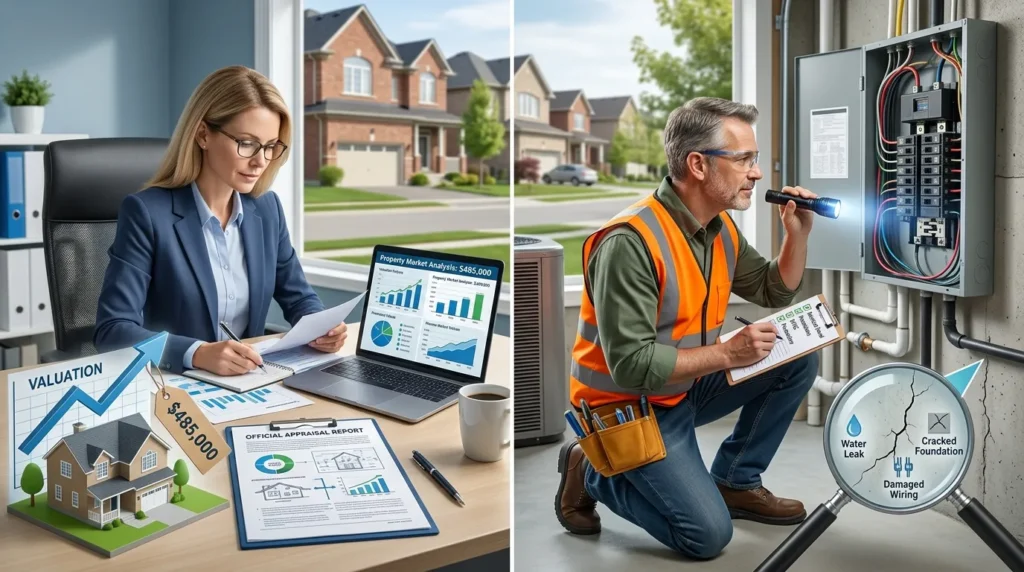
Does a home inspection affect my appraisal? The inspection and appraisal are completely separate. The appraisal is ordered by the lender to establish market value. The inspection is ordered by you to assess physical condition. However, if your inspector documents major defects that could affect habitability or safety, an appraiser who later sees those items in the disclosure may note them. Keep them separate in your thinking — they serve different purposes.
Is a home inspection required by law in Maryland? No state law requires buyers to get a home inspection. But most purchase contracts include inspection contingencies, most lenders require documentation of condition, and Maryland’s older housing stock makes inspections genuinely necessary — not a formality.
Can I skip the inspection to make my offer more competitive? Some buyers in hot Maryland markets waive inspection contingencies to compete. That’s a different decision from skipping the inspection entirely. Many buyers in competitive situations conduct a pre-offer walkthrough with an inspector or schedule inspection immediately after ratification with a short contingency window. Talk to your agent about the specific market conditions for the property you’re pursuing.
What pre-1980 issues should I specifically ask my inspector about? In Maryland homes built before 1980, ask about: galvanized steel supply lines (check water pressure at upstairs fixtures), electrical service capacity (60-amp service is insufficient for modern loads), presence of knob-and-tube or aluminum branch circuit wiring, asbestos-containing materials in pipe insulation or vinyl floor tile, original cast iron drain lines (corrosion and offset joints are common), and basement waterproofing — or the lack of it.
What does Alhumd’s same-day report actually include? Digital delivery with organized sections for each building system, color photographs tied to specific findings, severity classifications (safety concern / major defect / maintenance item / informational), and written descriptions in plain language. Inspection video documentation is provided when additional visual clarity is needed.
How do I book with Alhumd and get the $20 discount? Schedule online at alhumdinspections.com and enter promo code SELFSCHEDULE at checkout. Or call (667) 686-7281 directly to schedule and ask about current pricing.
Does Alhumd serve my area? Alhumd serves all of Maryland — Baltimore City and County, Howard, Montgomery, Frederick, Anne Arundel, Prince George’s, Washington, and surrounding counties. Specific communities include Columbia, Ellicott City, Rockville, Gaithersburg, Bowie, Frederick, Germantown, Silver Spring, Annapolis, Towson, Hagerstown, Bethesda, Glen Burnie, Clarksburg, Urbana, and Odenton.
Schedule Your Inspection
Alhumd Inspections has completed 2,000+ inspections across Maryland with an 800+ five-star Google review record. Licensed, insured, and equipped with thermal imaging cameras and drone inspection capability.
📞 (667) 686-7281 🖥 alhumdinspections.com — use code SELFSCHEDULE to save $20 📋 Same-day digital reports. Every inspection.