Discovering mold in your house is worrying enough without wondering how much it will cost to determine just how bad it is. The average homeowner does not know what to expect when it comes to mold inspection prices since most have not done one previously.
In this article, we explore what mold inspection price involves, what makes it increase or decrease and some aspects that rarely come up in other pricing guides like clearance testing after mold remediation and the conflict between the inspector and the insurance company. Alhumd Home Inspection made this for you in order to give you a straight answer even before picking up the phone.
Worried About Mold? Get Answers Before It Gets Worse
Hidden mold problems can lead to costly repairs and health concerns. Alhumd Home Inspection provides detailed mold inspections with professional testing options to help you understand the issue and make the right decision.
What a Mold Inspection Actually Costs
As a general rule, a mold inspection will cost anywhere from $300 to $1,050, although this figure will vary according to the size of your home and the extent and accessibility of the contaminated areas. The minimum that you may have to pay for a simple visual inspection without samples sent to a laboratory could be around $150 to $250. If air or surface samples need to be collected, then the cost would be anywhere from $400 to $700.
| Inspection Type | Typical Cost |
| Visual-only inspection | $150 – $250 |
| Visual + single air sample | $350 – $500 |
| Visual + surface sampling | $400 – $650 |
| Whole-home comprehensive inspection | $900 – $1,800 |
| Large or complex property (4,000+ sq ft) | $1,800 – $3,000+ |
What Drives the Price
A handful of variables shift the final number more than people expect.
Number of samples collected. Each individual air or surface sample sent to a lab typically costs $50 to $150 on its own. Homes with multiple suspected problem areas need more samples, and the lab fees add up fast.
Accessibility. Mold hiding behind drywall, under flooring, or deep in a crawlspace takes more time and sometimes more invasive access, which raises labor cost.
Home size and layout. More square footage means more area to walk, photograph, and test.
Severity. A single damp corner in a bathroom is a quick job. A widespread infestation across multiple rooms requires a longer visit and more lab work.
Tools That Affect What You’re Paying For
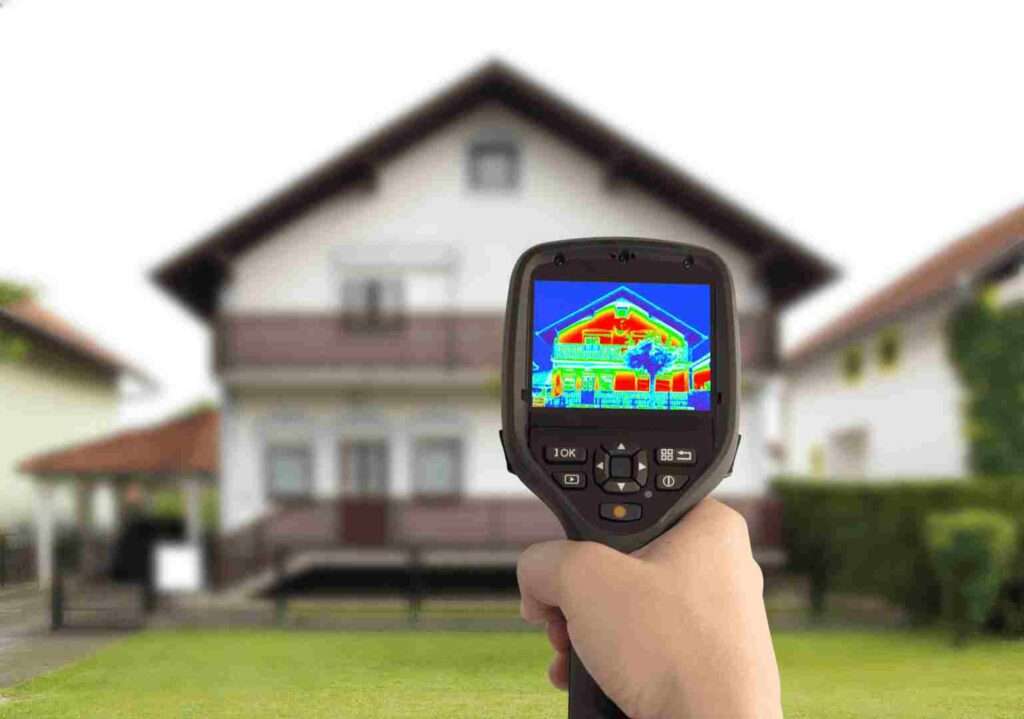
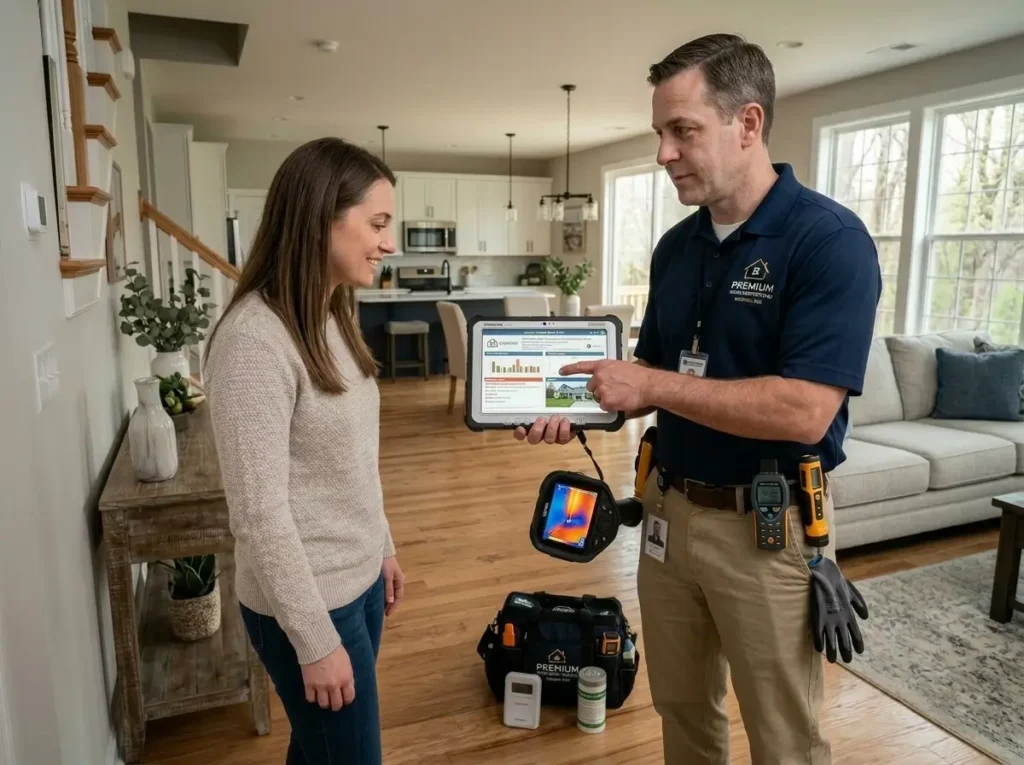
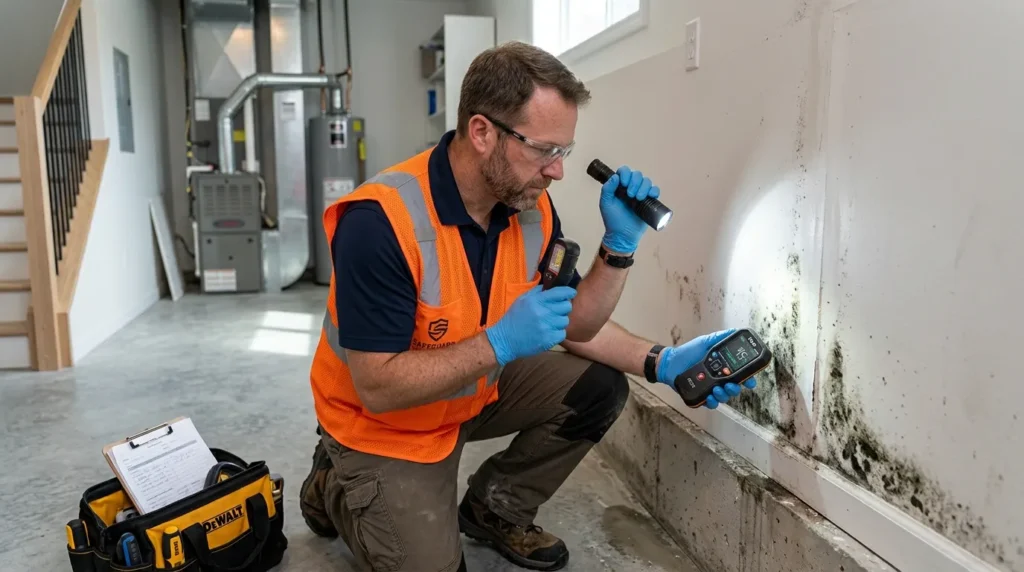
The tools used in a professional inspection are part of what you’re paying for. Moisture meters are able to locate high levels of moisture in drywall, wood, and concrete that have not yet become visibly covered in mold. Infrared cameras can locate temperature discrepancies that help locate leaks that might be located behind walls or underneath the floor. The air sampling pumps and swabs are what gets sent off to a lab in order to identify the species. If a quote doesn’t include these tools, just a quick walk through, then it’s usually going to cost less for a good reason.
Another misconception is that all molds need to be sent off to a lab to identify their species. Mold on the surface of your bathroom is easily identifiable and a professional mold removal expert should be able to tell you when there is no need for lab testing.
The Cost Gap Nobody Talks About: Clearance Testing
The equipment employed in professional inspections is one of the services you are being charged for. Moisture detectors can detect moisture accumulation in drywall, wood, and concrete that has not yet started growing mold. Infrared detectors will show where there is temperature difference in order to find leaks that could be hidden behind walls or under the flooring. It is the air sampling pumps and swabs that are sent to the lab to identify the species. If the quote does not have these services, but simply involves walking through the premises, it will most likely be cheaper for a very good reason.
Another false impression about mold removal is that all molds must go to the lab to be identified. Mold on the bathroom’s surfaces is easy to identify, and you should be told by a mold removal specialist whether it is necessary to do so.
DIY Test Kits vs. Professional Inspection: What You’re Actually Paying For
The do-it-yourself mold test kits cost between $10 and $40 at a hardware store, which means that they are very easy to try out if you need to reduce expenses. However, there are things that these kits cannot show you. Mold spores are always found in almost any house, but it does not mean that they are harmful or even that they come from certain sources.
| Factor | DIY Kit | Professional Inspection |
| Cost | $10 – $40 | $300 – $1,050 |
| Detects hidden mold (behind walls, HVAC) | No | Yes |
| Identifies mold species | Rarely accurate | Yes, lab-confirmed |
| Locates moisture source | No | Yes |
| Usable for real estate transactions | No | Yes |
| Lab-backed results | No | Yes |
If you’re buying or selling a home, a DIY kit result generally won’t be accepted as documentation anyway, which makes the professional route the only real option in that situation.
Does Insurance Cover a Mold Inspection?
This will totally depend on your policy and the source of the mold. The majority of home owners’ insurance does not cover mold resulting from neglect, high humidity or poor maintenance. If the mold occurs due to the occurrence of an insured event such as pipe bursts or storm damage, then there are chances that your mold inspection and removal will be covered. It is recommended that you first contact your insurance company before scheduling anything, because some policies require that the inspection be done after the occurrence of the event.
Bundling Mold Testing With a Full Home Inspection
Since you’re going to be having a general home inspection conducted anyway, then you can ask if it’s possible to combine the services into one to save money. This can be easily done with inspection companies like Alhumd Home Inspection, who will give a discount price for mold testing as long as you have the service included in the package of your home inspection.
How to Choose a Mold Inspector Without Overpaying
- Confirm they’re not also doing the remediation. A company that inspects and remediates has a financial incentive to find more than what’s actually there.
- Ask what’s included in the quoted price. Some companies quote a low base rate and then charge separately for every single sample.
- Check state licensing requirements. Several states require mold inspectors to hold a specific license or certification separate from general home inspection credentials, and you should confirm this before booking.
- Ask about turnaround time on lab results. Standard results take 2 to 5 business days, but rush processing is often available for an added fee if you’re on a tight timeline.
- Get the sampling plan in writing. A vague quote with no explanation of how many samples are included is a common way homeowners end up with surprise charges.
Signs You Should Schedule an Inspection Sooner Rather Than Later
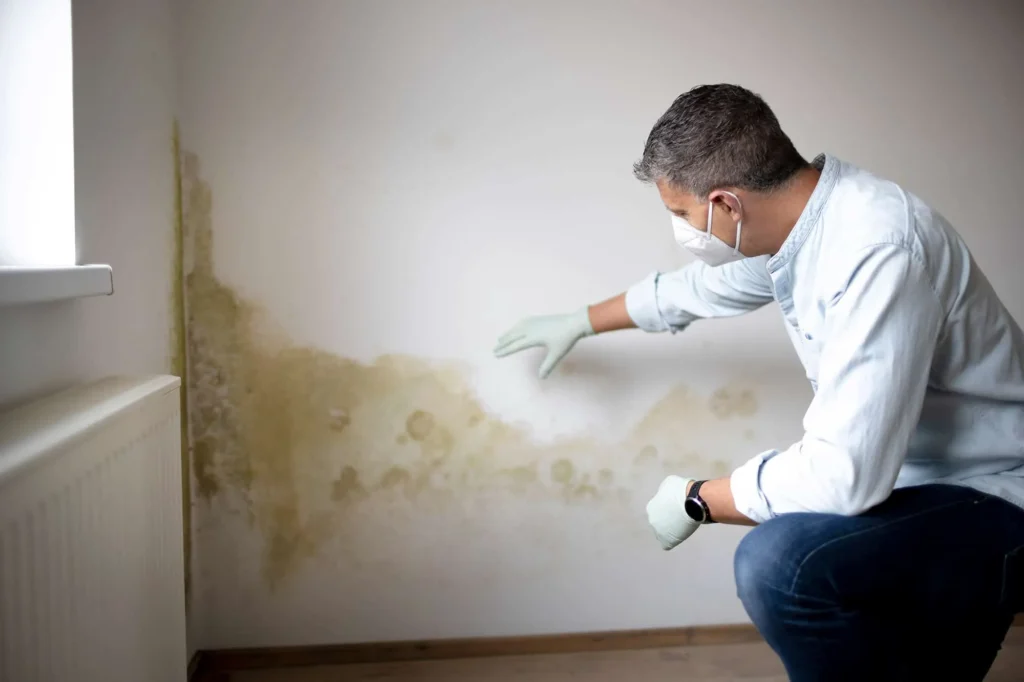
Mold growth or discoloration, musty odor, presence of any water damage, and any unexplained respiratory problems are some indicators that require immediate action and not waiting. This is because mold grows when it is left unnoticed, and its treatment becomes more expensive as time passes by. Mold growth that is isolated and noticed early on can be very cheap compared to mold that is extensive and has been allowed to grow for months.
What Happens After the Inspection
In case of mold presence, your report will describe where the mold grows, the degree of contamination, and the type of mold present. Then a professional mold remediation company deals with the problem, and based on the size of the contaminated area, this process may take from a few days up to two weeks. After remediation is finished, organize that clearance test before assuming that the problem is solved; otherwise, you might find yourself faced with the same problem six months later.
Final Thoughts
In terms of the cost of mold inspections, it depends on how many tests are required to diagnose a problem rather than the size of the structure. For example, if there is a small-scale mold problem, a visual examination is all that is needed. Conversely, when there is a large-scale issue, then testing needs to be done throughout and a lab analysis performed. The one thing that many property owners do not consider is testing for building clearance, which will help ensure that the same expense is not incurred a second time.
For more information regarding mold inspections or other types of property issues that require testing, get in touch with Alhumd Home Inspection today. We will work to find out which testing services are needed and will provide you with an estimate that will include all expenses.
Don’t Guess About Mold — Get a Professional Inspection
Whether you are buying a home, dealing with moisture issues, or need confirmation after remediation, Alhumd Home Inspection helps identify mold concerns with clear findings and reliable reports.
FAQs
Generally speaking, most homeowners spend about $300 to $1,050 for the process.
Certainly not if I’m dealing with something serious. DIY testing kits can neither reveal hidden mold nor help determine its species, which makes them unreliable during the real estate deal process.
Clearance testing comes after remediation work has been done. This separate service costs around $200 to $500 and without it, I have to trust the remediation company that its work was done right.
It may, but only if the mold appeared due to an insured event such as broken pipe, and not because of negligence or high humidity levels.
Yes, most likely. For example, I know that at Alhumd Home Inspection, a customer can receive a special rate in case mold testing is ordered along with a full house inspection performed on the same day.